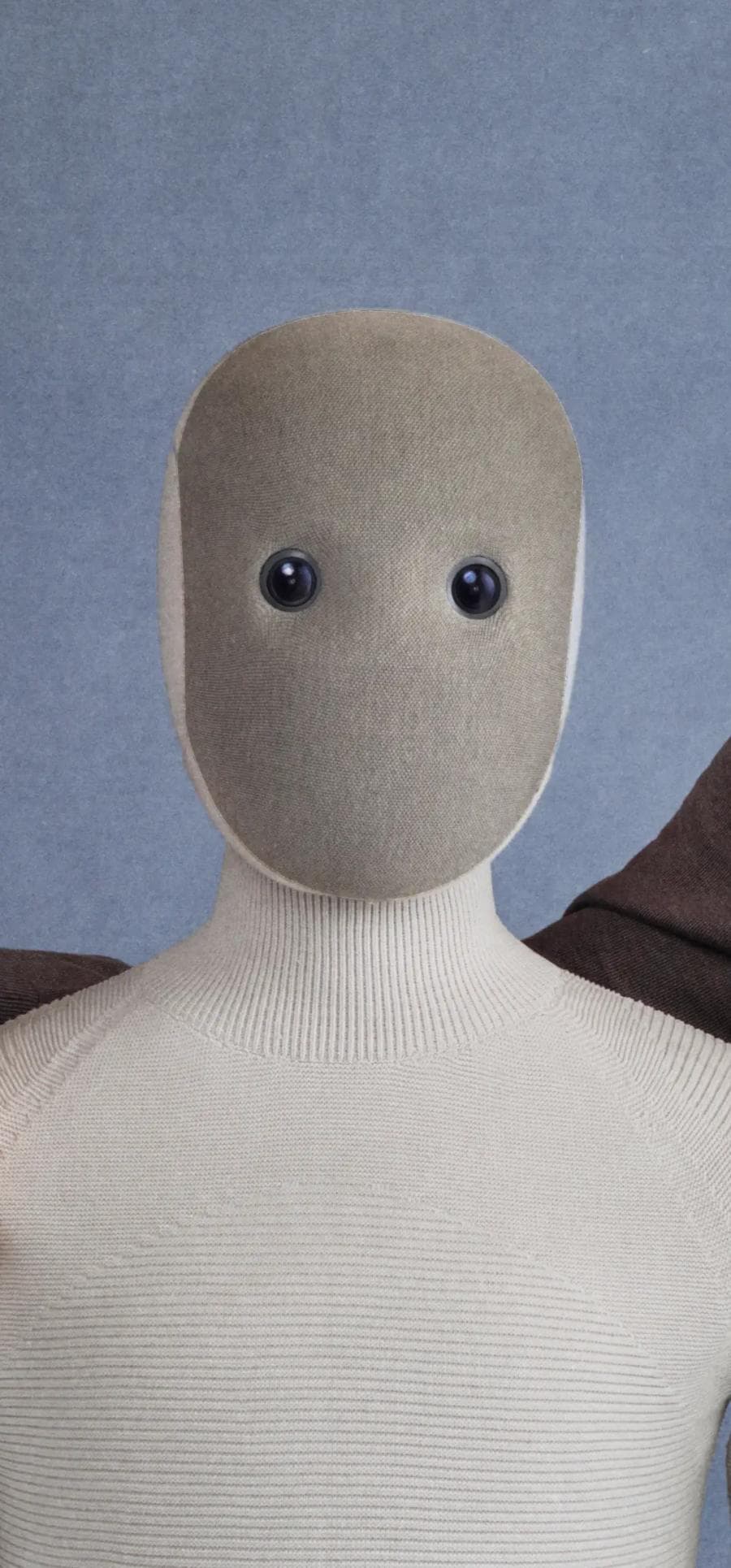
Founded in 2014 as Halodi Robotics by Norwegian roboticist Bernt Børnich and rebranded 1X in 2022, the company made an early, contrarian bet: while most of the field chased the factory, 1X aimed straight for the living room. It consolidated its headquarters in Palo Alto in 2025 but kept its engineering roots in Norway, and its thesis is that a robot meant to share a home must be fundamentally safe — light, soft, and compliant — even at the cost of raw strength.
The bet: soft enough for the living room
That philosophy is the entire design of NEO: a roughly 30-kilogram machine wrapped in a knit suit over a soft 3D-lattice polymer body, driven by proprietary tendon-like actuators rather than rigid industrial joints. In October 2025 it became the first home humanoid offered to ordinary buyers with a real price and a delivery window — $20,000 outright or $499 a month, against a refundable deposit, with first US shipments slated through 2026. Backing comes from the OpenAI Startup Fund (which led an early round) and EQT Ventures (which led the $100M Series B); the company has disclosed north of $130M raised, and was reported in late 2025 to be seeking far more at a $10B-plus valuation — though that round was never confirmed closed.
Where it stands
1X is unusually candid about the catch, and you should be too. NEO is not reliably autonomous: when it meets a task it can't handle, the owner schedules an "Expert Mode" session in which a remote 1X operator pilots the robot through a VR headset, seeing out of its cameras — a real person, in your home, by video. That teleoperation isn't only a crutch; it's the data engine training NEO's onboard "Redwood" AI. Børnich's stated goal of a "mostly autonomous" robot in 2026 is, for now, an aspiration with a wide gap to today's reality.
The strategy is also quietly hedging. In December 2025, 1X agreed to put up to 10,000 NEO units into the warehouses and factories of EQT's portfolio companies through 2030 — worth noting that EQT is also an investor, which makes it a related-party deal. The living-room dream is intact; enterprise revenue is the bridge meant to fund the journey there.