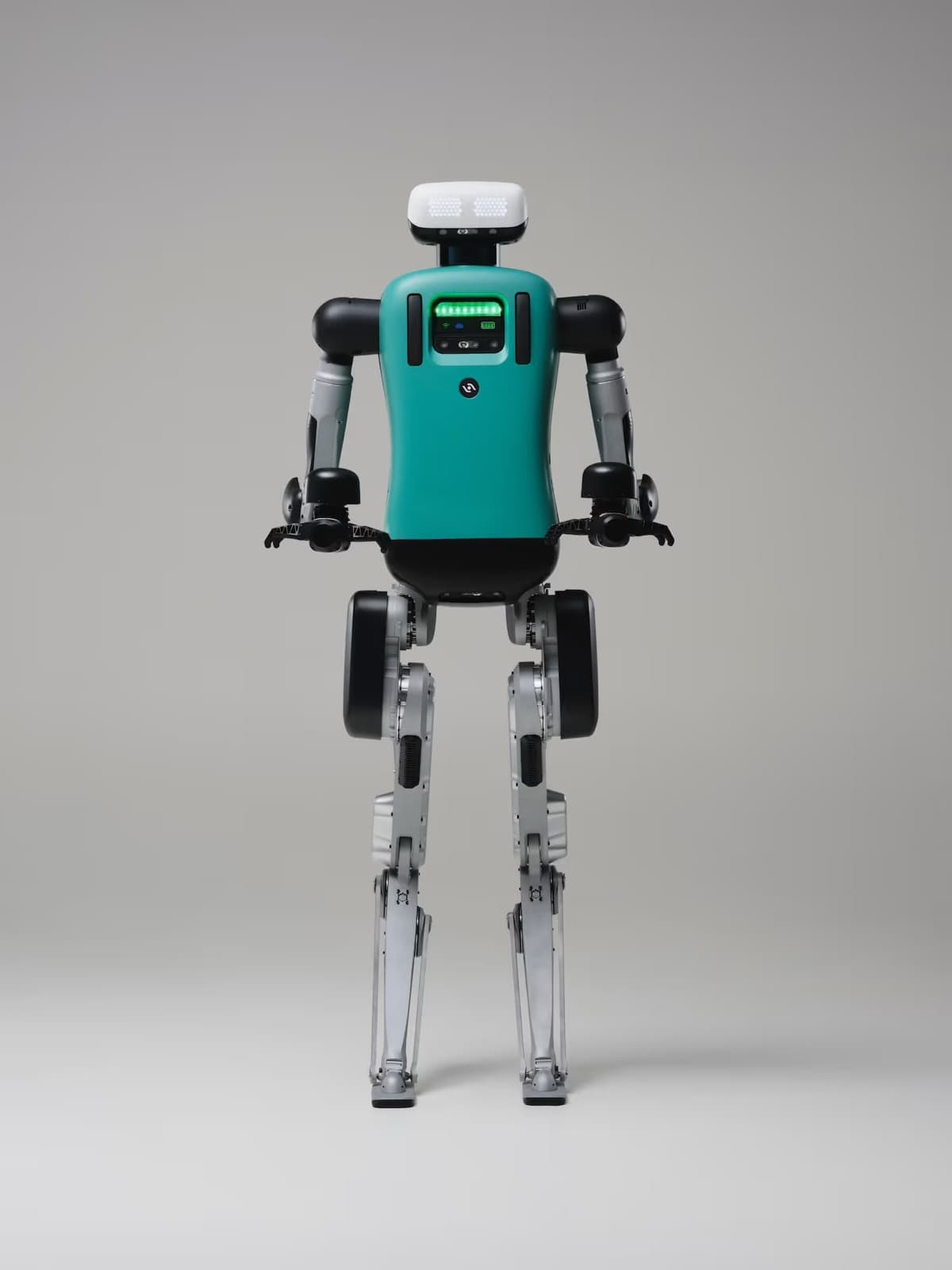
If most humanoids in 2026 are still demoing, Agility's Digit is clocking in. Founded in 2015 and spun out of Oregon State University's Dynamic Robotics Laboratory, Agility was built by Jonathan Hurst, Damion Shelton and Mikhail Jones on a decade of legged-locomotion research — the ostrich-like Cassie biped came first, then the arms-and-torso Digit, designed to do real warehouse labour.
Its bet is the opposite of the companion makers': no face, no warmth, no pretense of a relationship. Digit is genderless and industrial, pointed squarely at logistics — moving totes and bins, tending lines, walking the same floors people do on reverse-jointed legs.
The receipts
The traction is real and unusually well-documented for this field. Agility says Digit has logged more than 65,000 hours across nine customer facilities, with named, paying deployments at Amazon, GXO Logistics, bearings giant Schaeffler (which also took an equity stake), Mercado Libre and Toyota Motor Manufacturing Canada. It sells outright and as Robots-as-a-Service, and builds at RoboFab in Salem, Oregon — a factory sized for up to 10,000 units a year.
The capital is following. Led since 2024 by CEO Peggy Johnson (ex-Magic Leap and Microsoft), Agility agreed in June 2026 to go public via a $2.5 billion SPAC merger with Churchill Capital Corp XI, raising more than $620 million — roughly $200 million of it in a PIPE led by manufacturing partner Foxconn.
Why include a faceless work robot on a site about companions? Because Digit is the field's reality check. It scores near-zero on the things that make a machine feel like a person, but it is among the very few humanoids doing genuine, paid, repeatable work — the industrial floor on which the warmer, more intimate machines are still only being imagined.
From this maker