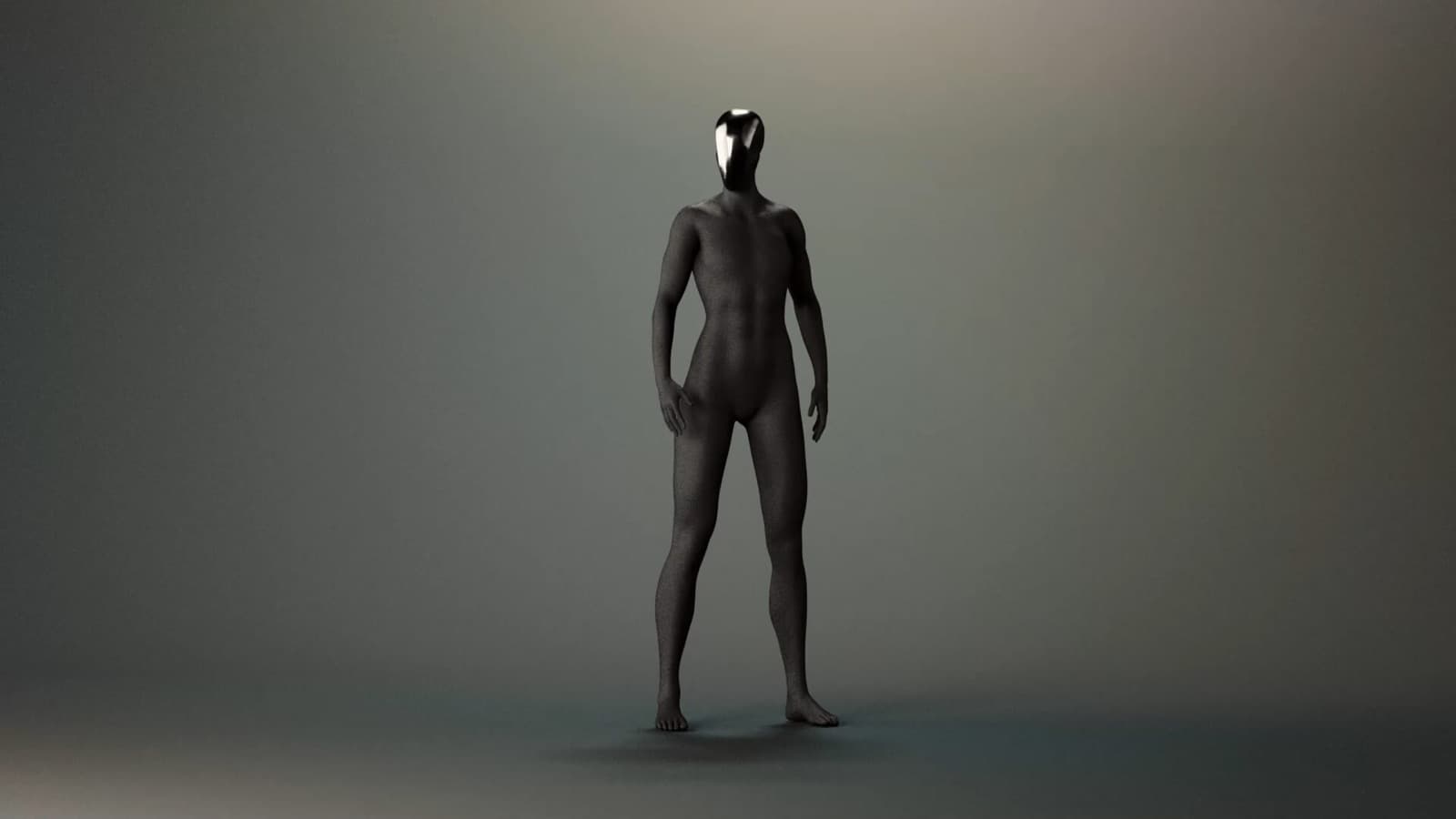
While the rest of the field bolts rigid electric motors to metal frames, Clone Robotics is trying to rebuild the human body from the inside out. Founded in 2021 by Dhanush Radhakrishnan and Łukasz Koźlik — in Poland, now with a second office in Mountain View — the company's core invention is Myofiber: artificial muscle that contracts when water is pushed through it under electric control, layered over a polymer skeleton with bone-like structure and cable "tendons."
The bet: rebuild the body, don't bolt on motors
The result, shown in the viral Protoclone prototype unveiled in early 2025, is a faceless machine of more than a thousand artificial muscles, 200-plus degrees of freedom and as many sensors, that twitches and flexes like something alive rather than something assembled. It is the most biologically ambitious approach in this directory and the eeriest to watch — even New Atlas, reporting the demo, conceded the suspended prototype "isn't ready to vacuum carpets." The pitch is a general-purpose household android — laundry, cooking, chores — explicitly not a companion or intimacy product, despite how lifelike the body looks. The company has opened reservations for a limited Clone Alpha run of 279 units, targeting an eventual price near $20,000.
Where it stands
Two clarifications keep it honest. First, almost everything is still aspirational: no complete unit has been shown doing a real task, the suspended prototype only twitches and kicks, and most claims are self-published. Clone's own roadmap pushes a tool-using torso to late 2026, human-like walking to 2027, and a first commercial product — a hotel "robo-butler" — out to 2028. Second, the money is modest for the ambition: roughly $17M raised to date (anchored by a 2023 seed led by Initialized Capital, plus angels from the Y Combinator orbit), with a larger round reported to be in progress but not closed. There is no disclosed valuation and no published headcount.
Clone is the field's most fascinating science experiment — the one bet that, if it works, makes everyone else's metal-and-motor approach look like a detour. Whether it becomes a product, and not just the most unsettling video on the internet, is still an open question.