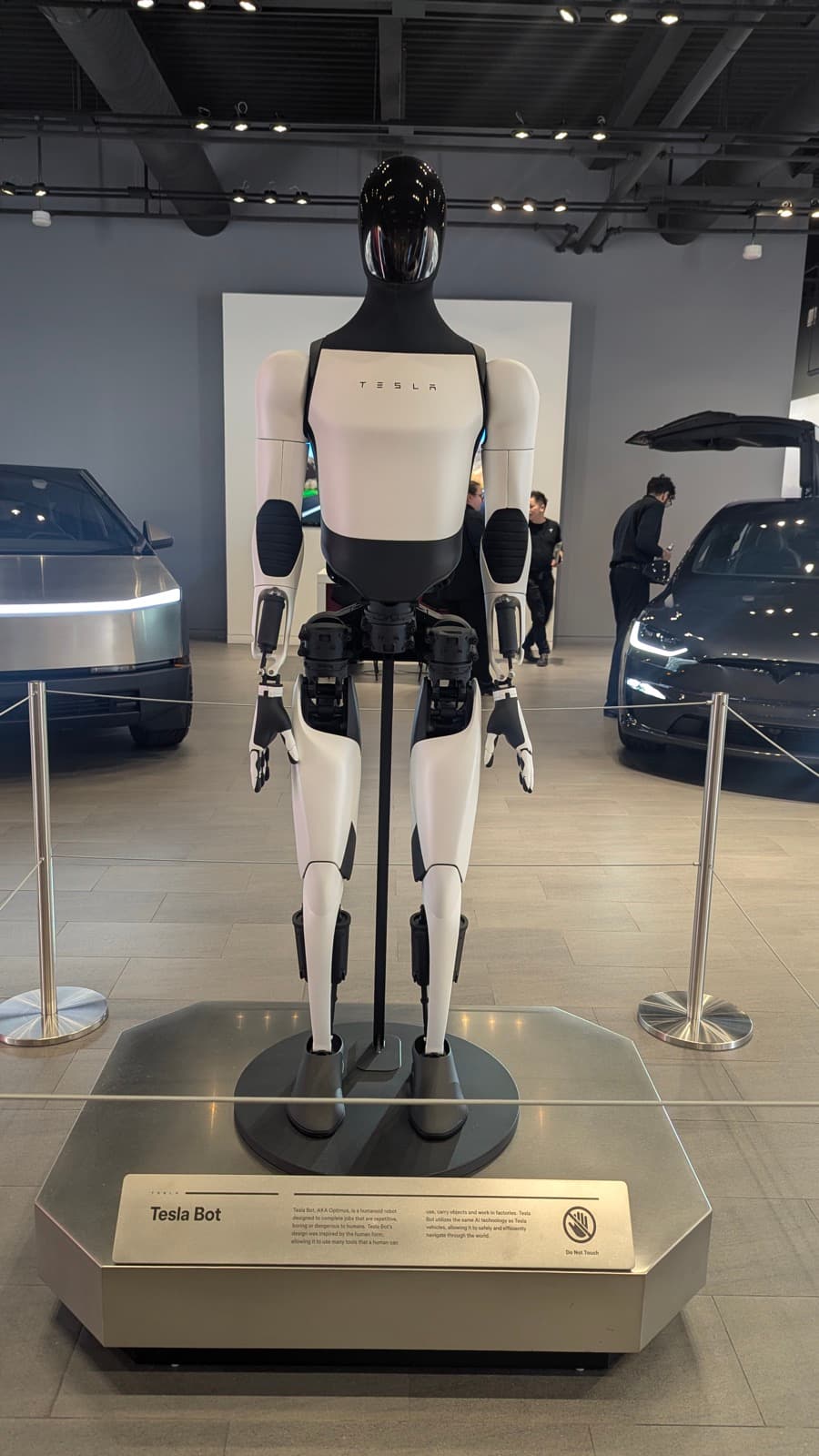
Tesla unveiled the Optimus program at its 2021 AI Day with a person in a bodysuit and a characteristically large promise: a humanoid built on the same perception stack as its cars, manufactured at automotive scale, eventually priced like a cheap car. A walking prototype followed in 2022. The pitch has never really been about companionship — Optimus is meant to work, first inside Tesla's own factories.
The bet: the car company's robot
Tesla's advantages are real and unusual in this field: in-house chips, batteries, motors, and the largest manufacturing base in the race to learn on. Most telling, the program is now run by Ashok Elluswamy, who also leads Autopilot and Full Self-Driving — a literal embodiment of the thesis that the robot and the car can share one brain and one perception stack. Tesla is converting its Fremont Model S/X line to build Optimus, with a second site planned at Giga Texas, and speaks of output eventually measured in the millions. The whole wager is manufacturing: if Tesla can stamp out humanoids the way it stamps out cars, it resets the price floor for the entire category.
Where it stands
The reality in mid-2026 is far more sober than the slides. The Gen 3 robot — promised, then promised again — remained unrevealed as of this writing, its reveal slipped to "mid-2026" with only slow production expected later in the year. More damning, Elon Musk himself conceded on the Q4 2025 earnings call that Optimus was "not in usage in our factories in a material way," and on the Q1 2026 call admitted no robots were yet doing genuinely useful work — while declining to give any 2026 production target. His January 2025 forecast of roughly 10,000 robots that year went unmet. And the viral claim that a thousand Gen 3 units are already labouring on Tesla's lines traces to SEO content farms, not to Tesla, and is flatly contradicted by Musk's own words.
We track Optimus not as a companion but as the gravity well of the whole category: if Tesla ever truly hits its automotive-scale cost target, every other maker's pricing math changes overnight. For now that remains a promise — backed by more manufacturing capacity than anyone else in the field, and less demonstrated useful work than its boldest rivals.
From this maker