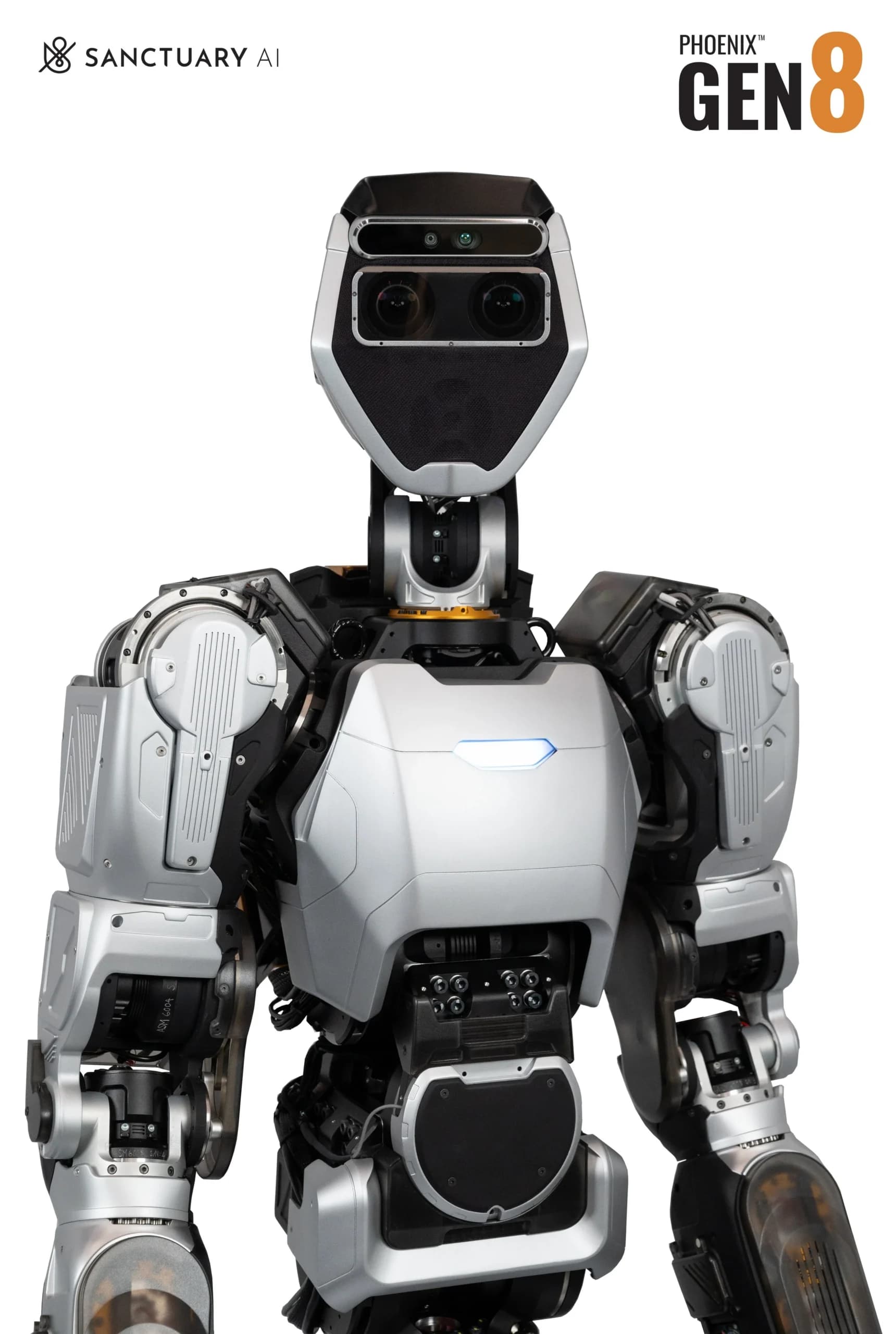
Sanctuary AI's obsession is the hand. Founded in Vancouver in 2018 by a four-person team — Geordie Rose, Suzanne Gildert, Olivia Norton and Ajay Agrawal — the company built Phoenix, a general-purpose humanoid whose headline feature is a hydraulically actuated hand with up to 21 degrees of freedom and fingertip sensors that register a few thousandths of a newton — by several measures the most dexterous, most sensitive hands in any commercial humanoid program. Its Carbon AI translates plain language into physical action.
The bet: it all comes down to hands
The wager is unusual in two ways. First, Sanctuary runs on hydraulics in an industry that has standardised on electric motors — a contrarian choice it argues is the only way to pack human-grade strength and speed into a human-sized hand. Second, in 2025–26 it stopped waiting on the full robot. Its new "performance-first," hardware-agnostic strategy is to deploy Carbon as Physical AI software on third-party commercial robots now, while developing its hydraulic hands as a distinct product — a more pragmatic, revenue-sooner path than shipping a complete humanoid. Be precise about it, though: there is not yet a standalone hand you can buy off the shelf, and the full-humanoid plan has been deprioritised rather than the hands fully productised.
Where it stands
The honest context is turbulence. Co-founder and CTO Suzanne Gildert left in 2024; the board ousted co-founder and CEO Geordie Rose later that year, and roughly thirty layoffs followed. After an interim stretch, Daniel Friedmann — a veteran of Canada's MDA Space, of Canadarm fame — took over as CEO and chairman in June 2026. Through it all, Phoenix has stayed pre-commercial and heavily teleoperated: its most impressive dexterity demos are typically piloted by a human, generating the data meant to bootstrap real autonomy. Funding stands above $140M — including a $30M grant from Canada's Strategic Innovation Fund and a partnership with Microsoft — and headcount, after the cuts, sits around 160.
If the future of companions runs through dexterous, sensitive hands — and it surely does, since holding and being held is the whole point — Sanctuary's are the ones to watch. The question it is now answering, the hard way, is whether the best hands in robotics can become a business before the money runs out.
From this maker