Sanctuary AI/Research
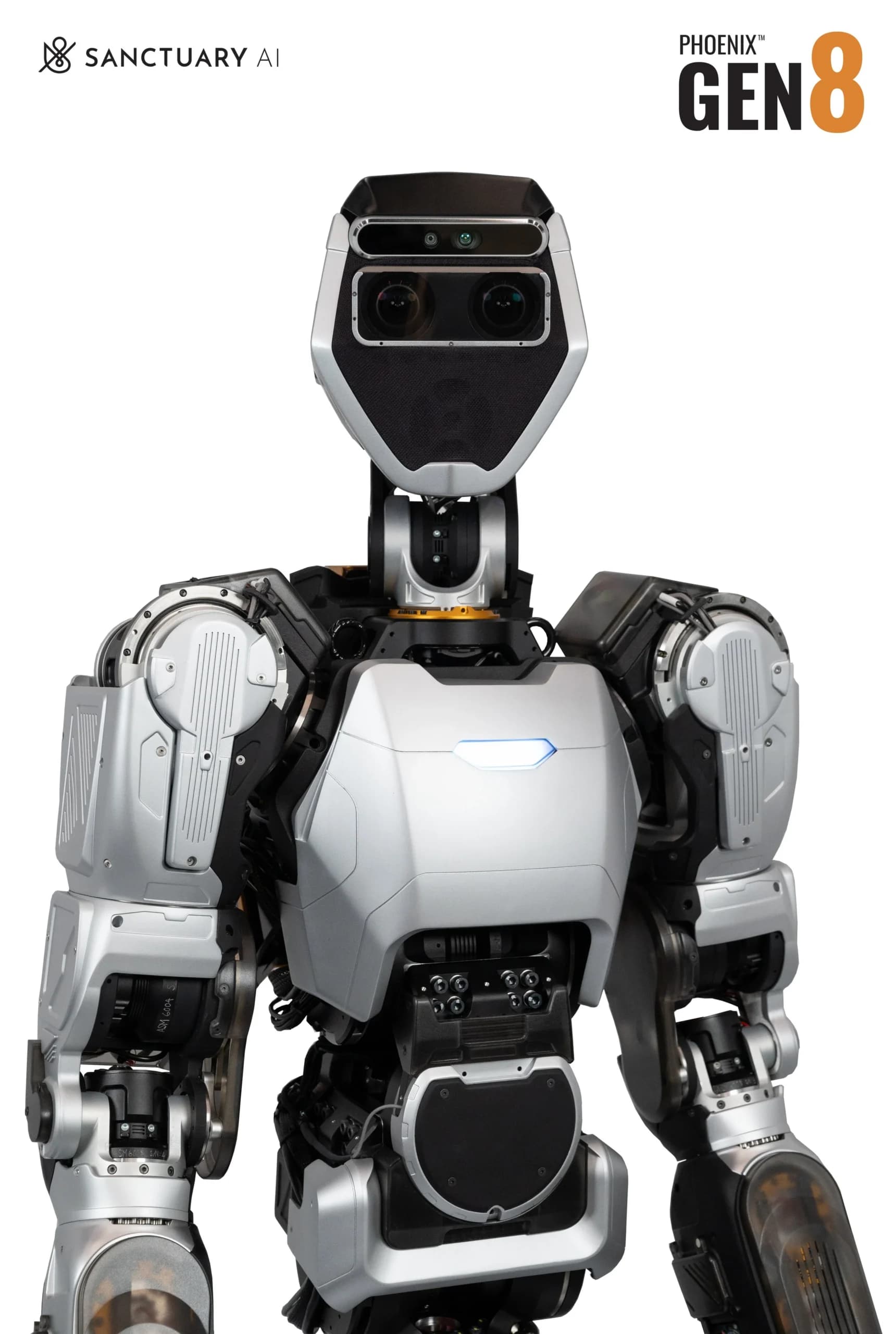
Phoenix
The most dexterous hands in robotics.
- Up to 21 degrees of freedom per hand
- Fingertips that feel a few thousandths of a newton
- Pivoting to sell the hands on their own
Realism index
30/100
Our editorial estimate of how close this machine is to a lifelike human companion — six weighted dimensions, built from public evidence. How we score · The whole field, ranked
See it move
Photos flatter; motion is where realism is won or lost.
Phoenix is a bet that the future of robots — companions included — is decided at the fingertips. Sanctuary AI's humanoid carries hands with up to 21 degrees of freedom each, driven by miniature hydraulics and tipped with sensors that register a few thousandths of a newton. By several measures, they're the most dexterous and most sensitive hands in any commercial humanoid program.
Everything else is in flux. Phoenix runs on hydraulics in an industry that standardised on electric motors; it leans heavily on human teleoperation; and in 2025–26 Sanctuary pivoted toward selling the hands as standalone units for industrial arms, amid layoffs and a leadership change. There's no public price and no volume deployment.
It earns its directory slot as the specialist's specialist. A companion that can hold your hand, button a shirt, or pour a glass without crushing it will need exactly what Sanctuary is obsessing over — and nobody is further along on touch.
Our verdict
The case for
- The most dexterous, sensitive hands in any humanoid program
- A strong manipulation-data pipeline with sim-to-real progress
- Hydraulics deliver high power density
The case against
- Leans heavily on teleoperation; not autonomous at scale
- Pre-commercial — no public price, no volume deployments
- Real organisational turbulence and a niche hydraulic bet
What it can do
- Fine in-hand manipulation and reorientation
- A teleoperation-to-autonomy data pipeline
- New tasks automated in under 24 hours
The paper trail
Dated milestones — announcements, prices, promised ship windows — as they were made. We add to this record; we don't rewrite it.
Former MDA chief Daniel Friedmann took over as the company pivoted toward scaling existing technology rather than proving out the humanoid.
Founding CEO ousted; layoffs follow
The board separated co-founder Geordie Rose from the company; roughly 30 staff were cut days later.
New tasks learnable in under 24 hours versus weeks, with 50% faster assembly and cheaper components, per Sanctuary.
A 170 cm general-purpose humanoid with 20-DoF haptic hands, powered by the Carbon control system.
Quick answers
Composed from the directory record above — so they can't drift from the data.
- What is Phoenix?
- Phoenix is a research-class machine (lab & exhibition) from Sanctuary AI (Canada). A pre-commercial humanoid whose hydraulically actuated hands are, by several measures, the most dexterous and sensitive anywhere.
- How much does Phoenix cost?
- Sanctuary AI hasn't disclosed pricing — Enterprise R&D — not publicly priced.
- Can you buy Phoenix right now?
- No — Phoenix has been announced but isn't orderable yet. The maker's current label is "Research & pilots".
- How lifelike is Phoenix?
- We rate Phoenix 30/100 on the gfs.ai Realism Index — an editorial score across six weighted dimensions, built only from public evidence. It scores strongest on motion (55/100) and weakest on face (3/100).
- Who makes Phoenix?
- Phoenix is built by Sanctuary AI — founded 2018, headquartered in Vancouver, Canada. The company's focus: dexterous manipulation and "physical ai" (phoenix).
Related reading
Keep exploring