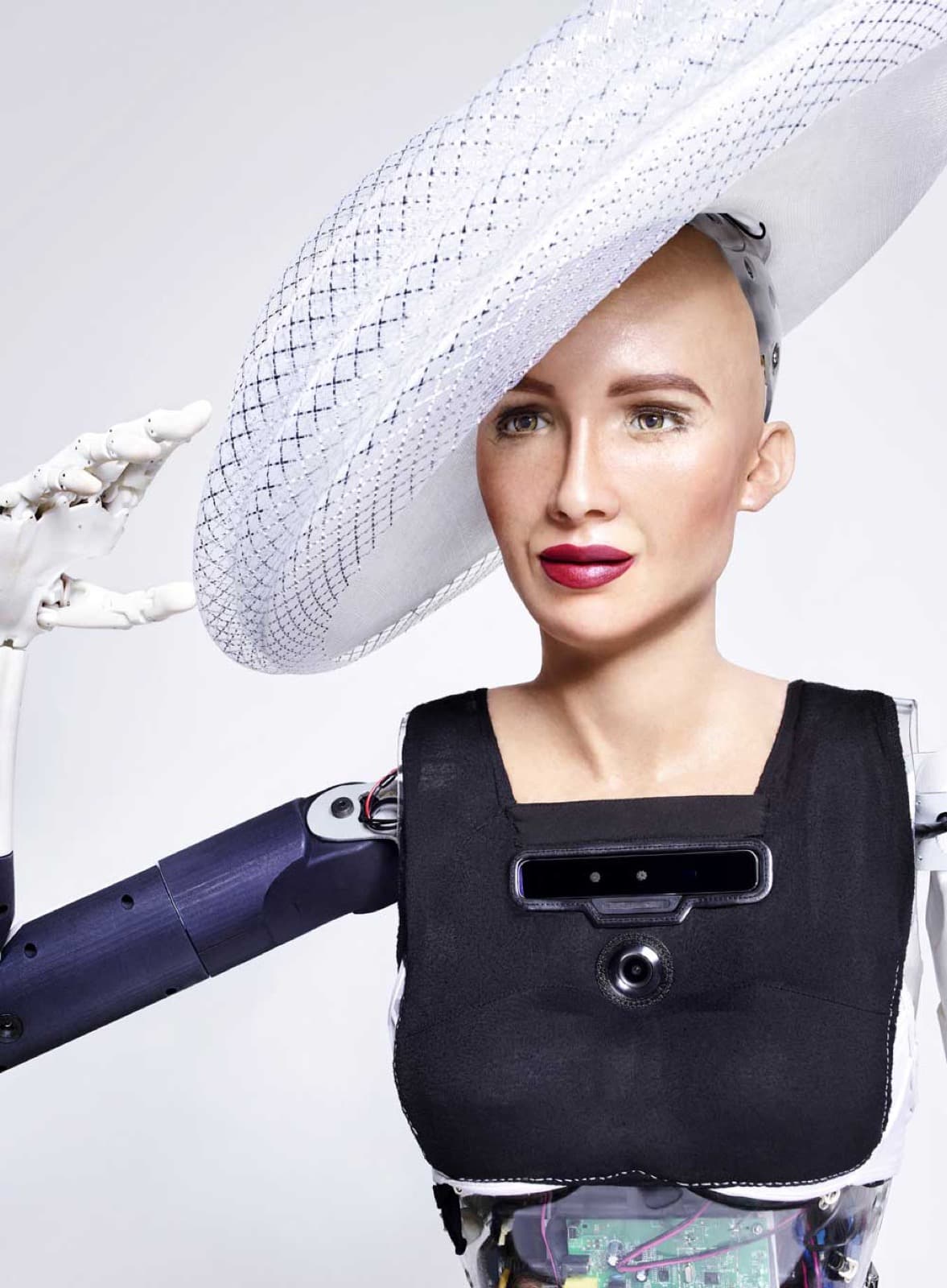
No company has done more to put a robot's face into the public imagination — and none has been argued about more for it. Hanson Robotics was founded in 2007 in Dallas, Texas by David Hanson, a former Disney sculptor, and moved to Hong Kong Science Park in 2013. Its obsession is singular: the human face, and the soft, expressive skin that makes one believable.
That skin is Frubber — a patented elastomer (the name elides "flesh rubber") that creases and wrinkles like the real thing under a lattice of small motors. It is the foundation of every robot the company is known for: Sophia, the most famous robot on earth; her eldercare-focused sibling Grace; the memory-driven BINA48; and consumer toys like Little Sophia and Professor Einstein.
The asterisk
Hanson's genius is expression and showmanship, not autonomy. Sophia's on-stage brilliance has always blended scripted lines, tele-operation, a chatbot and — lately — large language models, not the human-level mind her early press implied. The 2017 stunt of granting Sophia honorary Saudi "citizenship" drew headlines and a sharp backlash from AI researchers who felt the capability was being oversold. Read every autonomy claim here as a claim.
What is not overstated is the craft. No one renders a still, emotive, human-looking face better, and Hanson has refined it longer than almost anyone. The honest limits: the robots barely move below the neck, volumes are tiny, and the company is privately held with undisclosed funding, closely tied to Ben Goertzel's SingularityNET.
Hanson belongs in this directory as the keeper of the face — the half of the companion dream that lives in expression rather than locomotion. When a future companion finally meets your eyes and you forget, for a second, what it is, it will owe a debt to the skin Hanson spent two decades perfecting.