Engineered Arts/Research
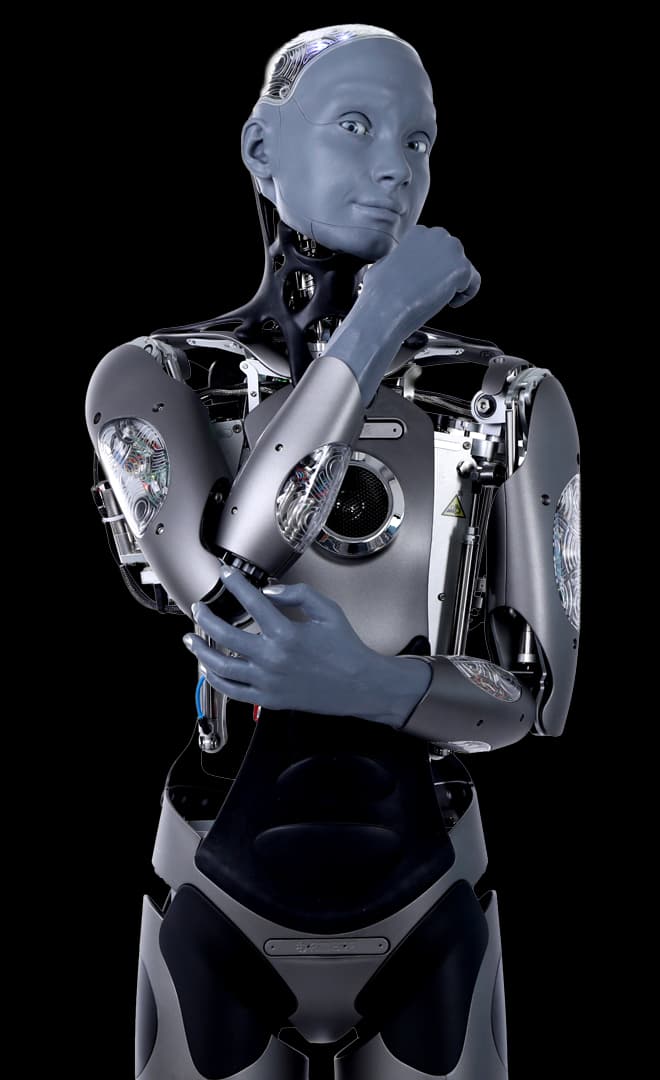
Ameca
The most expressive robotic face ever built.
- 27 degrees of freedom in the face alone
- Star of the most-watched "robot wakes up" clips
- Speaks 70+ languages via plug-in LLMs
Realism index
55/100
Our editorial estimate of how close this machine is to a lifelike human companion — six weighted dimensions, built from public evidence. How we score · The whole field, ranked
See it move
Photos flatter; motion is where realism is won or lost.
If you've seen a robot "wake up," look around in wonder, and react to being poked — that was Ameca. Engineered Arts' showpiece owns the single hardest problem in companion robotics: a face that moves like a face. With 27 degrees of freedom in the head, it raises an eyebrow, holds your gaze, and lets expressions build and fade with a fluidity nothing else on the market approaches.
It's not a companion, and it's honest about that. Ameca is a fixed-base, upper-body research and exhibition robot — it does not walk — sold to museums, labs, and stages by quote, or rented for events. Under its grey silicone, Tritium OS plugs into modern LLMs to converse in 70-plus languages.
We include it as the benchmark for the face. Every companion you'll ever care about is, in part, a bet on solving the exact problem Ameca has spent twenty years on. When one finally meets your eyes and convinces you, it will be standing on Engineered Arts' shoulders.
Our verdict
The case for
- Arguably the most expressive humanoid face on the market
- A modular, upgradeable, open developer platform
- A proven product with a real install base (and a rental option)
The case against
- Does not walk — fixed base, upper body only
- Not a labour or companion robot — built for expression
- Expensive and quote-only, for controlled indoor use
What it can do
- Uncanny, fluid facial expression that reacts to the room
- Real-time spoken conversation via integrated LLMs
- Telepresence — can mirror a remote operator's face
The paper trail
Dated milestones — announcements, prices, promised ship windows — as they were made. We add to this record; we don't rewrite it.
Engineered Arts raises a $10M Series A
Restructured as a US company to scale production of full-size and desktop Amecas.
October 2022 — joins Dubai's Museum of the Future
Hired as the museum's first robotic staff member.
An unscripted conversation video, answering via OpenAI's GPT-3 — an early glimpse of the LLM-powered social robot.
First public showing at CES 2022
Ameca met the public at the Venetian Expo after the viral video.
Show 1 earlier milestones ↓Hide earlier milestones ↑
The 'waking up' clip — Ameca examining its hands — topped 10 million views within days.
Quick answers
Composed from the directory record above — so they can't drift from the data.
- What is Ameca?
- Ameca is a research-class machine (lab & exhibition) from Engineered Arts (UK). A fixed-base research robot with the most fluid, expressive face in the world — the part of the companion dream that's hardest to fake.
- How much does Ameca cost?
- Engineered Arts hasn't disclosed pricing — Quote only — roughly $100k–$500k by configuration.
- Can you buy Ameca right now?
- Yes — Ameca is shipping to customers today. The maker's current label is "Order or hire".
- How lifelike is Ameca?
- We rate Ameca 55/100 on the gfs.ai Realism Index — an editorial score across six weighted dimensions, built only from public evidence. It scores strongest on face (80/100) and weakest on motion (18/100).
- Who makes Ameca?
- Ameca is built by Engineered Arts — founded 2004, headquartered in Falmouth, Cornwall, UK. The company's focus: expressive social and exhibition humanoids.
Related reading
Keep exploring